Analysing Brian Reid’s tenure at Somerset Park
It was Sheryl Crow who once sang “a change would do you good” while Cat
Stevens countered “It's not time to make a change. Just relax, take it easy”. I can only imagine that the singer-songwriter, multi-instrumentalist and
prominent convert to Islam hadn’t accounted for the
conclusion of Brian Reid’s 4 years and 205 days in charge at
Cat Stevens: wrong on this occasion
After a season that was at times odd-defying, claiming no fewer than three
SPL scalps on the way to three quarter-finals and a semi-final at the National
Stadium, Ayr United were relegated via the play-offs in heartbreaking fashion
at Somerset Park
The agreement not to renew Reid’s contract was mutual, with both the club and manager looking to take a new direction. Most fans also agreed his time was up. In a rare insight to the intentions of Chairman Lachlan Cameron, a statement on the official website announced the club’s wishes to place a greater emphasis on the ‘youth pathway to the first team’ and that in view of the ‘changing landscape in Scottish football’ a change had to happen. For Brian Reid’s part, it was time for a fresh challenge. Seaking to the Ayrshire Post on his departure, Reid said "even if we had stayed up in the First Division, the decision would probably have been the same". To what degree the budget cuts implicit in the Board’s new direction influenced his decision is open to speculation but it has been suggested he was unhappy.
Assessing Brian Reid's spell in charge at Somerset Park
Ayr ’s relegation the
following season would call into question these credentials. United kicked off
their Centenary season with the manager putting faith in the majority of the
squad that had won promotion via the play-offs. Defenders Alan Dempsie and
Scott Walker were the only regular starters from the previous season released,
with Billy Gibson and Andrew Aitken coming in as replacements along with Craig
Samson to provide competition to Grindlay.
The less said about David O’Brien’s Ayr United career the better.
In assessing the season just past, Brian Reid told the Ayrshire Post: “We had a small squad and the cup runs
probably had an adverse affect on our ability to stay in the First Division.
“If we had managed to stay up on the back of two good cup runs it would have gone down as one of the club’s best seasons.
“We were so near and yet so far.”
This can pretty much sum up his five years at the club. So near and yet so far from the title in 2009. So near and yet so far from First Division survival in 2010. So near and yet so far from beatingKilmarnock
in the biggest ever Ayrshire derby. So near and yet so far from staying in
First Division in 2012. It was reasonable to expect Ayr to win the title in 2009, and to avoid relegation in 2010 and 2012, and they were in good positions to do so each season but, ultimately Brian Reid failed on each occasion.
The agreement not to renew Reid’s contract was mutual, with both the club and manager looking to take a new direction. Most fans also agreed his time was up. In a rare insight to the intentions of Chairman Lachlan Cameron, a statement on the official website announced the club’s wishes to place a greater emphasis on the ‘youth pathway to the first team’ and that in view of the ‘changing landscape in Scottish football’ a change had to happen. For Brian Reid’s part, it was time for a fresh challenge. Seaking to the Ayrshire Post on his departure, Reid said "even if we had stayed up in the First Division, the decision would probably have been the same". To what degree the budget cuts implicit in the Board’s new direction influenced his decision is open to speculation but it has been suggested he was unhappy.
| Farewell Brian. |
Reid inherited an apparently unhappy dressing room in
October 2007 – just 10 league games into the season – after Neil Watt had
attempted to recreate his double promotion-winning Stranraer side of 2003/04
and 04/05 but found his methods to be unwelcome. Reid moved quickly to shake up
the squad: most of the ‘Stranraer six’ were released (Higgins, Hamilton, Corr,
Swift), Micheal Moore was ushered to the sidelines and in came a number short-term
loan signings, including Dean Keenan and Willie Easton. Ayr
finished the season in 7th place, the same position they were when
Watt resigned.
The players brought to the club during Brian Reid’s first
six months in charge – and first close season – demonstrated perhaps Reid’s
greatest strength: player recruitment. Reid
proved to be adept at squad building and bringing better players to the
club. He probably leaves in credit when
the good signings are balanced against the bad.
The team built – virtually from scratch – to tackle the Second Division
in summer 2008, winning promotion via the play-offs best demonstrates this.
Stephen Grindlay was an ever present between the posts and was, and still is, a
solid goalkeeper; Dempsie, Walker, Campbell and McGowan were a solid back-four. In midfield, Chris Aitken joined Ryan
Stevenson (already at the club) and Keenan and Easton in making over 30
appearances and upfront the scoring prowess of Bryan Prunty and Alex Williams
was supplemented by David Gormely and, from January, Mark Roberts. While, for example, Chris Aitken had his
(vocal) detractors, it’s hard to argue that any of the mainstays of that squad recruited
by Reid were bad signings.
 |
| Chris Aitken: unpopular but a good signing? |
The side did not start the season well. Ayr’s 1-0 at home to Dunfermline at the start
of December was just their second of the season and meant they were already six
points adrift of 8th position but two ahead of bottom placed
Airdrie. To Reid’s credit, he had
already identified that reinforcements were required and throughout the
following months. Ryan McGowan, Danny
Lafferty, Chris Mitchell, Rocky Visconte and Stephen Reynolds and Danny McKay
all came in on loan. Veterans Junior
Mendes and Steve Bowey renewed acquaintances with former team-mate Reid and Tam
McManus returned from Ireland
with the promise of goals.
But it wasn’t enough. Four wins and no defeats in eight
games between mid-February and mid-March offered hope. Ayr jumped out of the relegation places for
five weeks and with nine games left to play were on the same points as Morton
with a game in hand, and nine ahead
of Airdrie – but Ayr finished the season
disastrously. Eight defeats interrupted
by a solitary victory at Firhill meant that United finished 10th, two
points behind Airdrie in the play-off position and six behind Morton in, who
defeated Ayr in the final game of the season. Three weeks previous, Airdrie
United had travelled down to Somerset
Park Inverness
sealed the title with a 7-0 rout.
This spectacular collapse is a major black mark on Reid’s
report card. Failure to beat Raith Rovers to the title the previous season was
a disappointment softened by play-off success. Finishing below Airdrie United –
the First Division’s only other part-time side – in the manner in which Ayr did was a major failure.
Following relegation Reid was given the opportunity to
rebuild once more. A previous blog post
chronicles that season from the perspective of Ayr’s main rivals that season: Livingston . Two
seasons previously, Ayr and Raith competed
mainly as equals. This time round the West Lothian club had an advantage as the Division’s only
full-time side. The Honest Men did have the opportunity at the start of
February to close the gap between the sides to one point (United having a game
in hand) but the Lions won 3-0 and went on to win the title by 23 points.
Ayr were partly undone by a combination of bad weather –
just two league games were played between the end of October and start of
January – and a Scottish Cup run that saw them reach the quarter-final,
defeating Hibs in a replay at Somerset Park on the way. Of the resulting
rescheduled fixtures played mid-week, Ayr won
just one of six. Reid’s side fell well
short of the standards set in his first full season in charge – earning 15
fewer points, losing over twice as many games – but again the season was
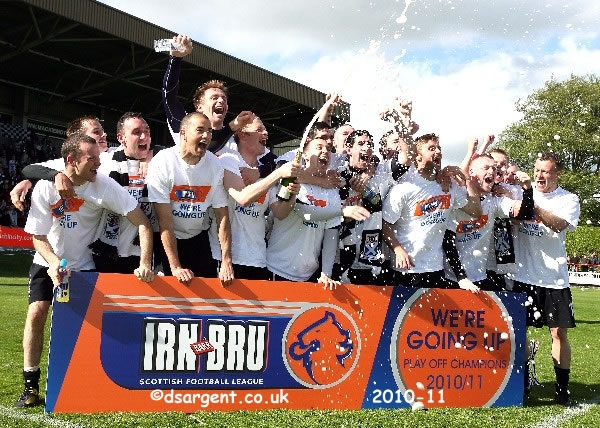
redeemed by triumph in the play-offs. While
few United fans present will forget the scenes of jubilation at Glebe Park
In assembling a squad for a second attempt at the First
Division survival, Brian Reid again had to go back to the drawing-board. Alan
Martin, the former Scotland U21 keeper brought in as Reid quickly realised
first choice David Crawford wasn’t up to the job, and central midfield
partnership of Ryan McCann and Scott McLaughlin left for full-time football elsewhere.
Kevin Cuthbert, Andy Geggan and Micheal McGowan proved to be adequate
replacements, and experience was added in the shape of the returning John
Robertson and Gareth Wardlaw.
Reid’s biggest error this season, however, was not bringing
another centre-back to the club. Ayr started
the season with a back four of John Robertson, Campbell, Smith and Malone but
injuries and suspensions meant they started just four league games – and
finished just one. Campbell endured (another) injury hit season,
starting only seven league games. A straight replacement for Campbell would have negated the requirement for
wholesale defensive changes: full-backs Robertson and Malone, Ross Robertson
and even Andy Geggan all stepping in to partner Chris Smith, often weakening
other area of the team. Mid-season, Liam Tomsett was an important capture on
loan from Blackpool and was a definite upgrade
on Alex Burke (perhaps Reid worst signing ever) and Jamie McKernon alongside
Andy Geggan in centre midfield. Sean Higgins and Keigan Parker were added as a
4th and 5th striker - but no defender.
| Alex Burke: one to forget |
The similarities between 2010 and 2012 are striking. With ten
games to go, Ayr were in eight place and had
been there for four weeks. This time round the gap over the side at the bottom
(Queen of the South) was six points and two points ahead of Raith in 9th.
In both seasons Ayr ’s 27th game was
away to Raith Rovers and United fans travelled to Kirkcaldy in big numbers.
Hopes of First Division safety were raised and then dashed as United conceded last
minute equalisers. Like in 2010, this
set back proved to be the catalyst for an end of season collapse. It was the
start of three games in quick succession versus relegation rivals, Rovers,
Morton and Queen of the South. Brian Reid’s men failed to win any of them:
drawing at home to Morton and losing 2-1 away to Queen of the South. Ayr had blown the opportunity to almost secure their
safety. Haunted by the spectre of throwing it away again, wins against
Livingston and Dundee , thanks to two spectacular
goals from Keigan Parker, weren’t enough to avoid the play-off position and
Raith and Morton picked up the points required to stay ahead of the Honest Men.
While 9th position was an improvement on last
time in the First Division, particularly in a league where Ayr were the only
part-time side, but any sense of achievement was soon to be diminished as Ayr
crashed in the play-offs where yet another vital game – ironically again
against Airdrie at Somerset Park – was lost. A United team under Brian Reid
beaten by a side that was better organised and drilled and looked like they
wanted it more.
This brief sojourn through Reid’s four full seasons in
charge indicates a number of recurrences: losing vital games at important times
of the season; poor end-of-season form and a huge turn over in players from one
season to the next, even during seasons.
The turnover of players partly reflects the state of
Scottish football today and Ayr United’s standing – a part-time team somewhere
between the First and Second Division. One year deals are the norm and players
will inevitably be looking to for full-time contracts. Brian Reid was able to capitalise on the new economics in the game, recruiting decent players such as Eddie Malone, Ryan McCann and Chris Smith who in recent years would have commanded full time football. The criticism can be levelled at Reid, however, that he was
always looking to improve his squad through new players rather than on the
training ground. It seemed that the solution (to not scoring goals, particularly) always lay with a new player and the excuses lay in an inability to find someone "better than we already had".
On the park, a number of failings were evident and
persistent. While I think Brian Reid wanted his side to play 'the right way', they were often strangled by Reid's conservatism. Defensively, his first preference was for full-backs who were first and foremost solid. The likes of Alan Dempsie, Neil McGowan and even Eddie Malone (set-pieces aside) rarely offered anything in an attacking sense. The signature of Jim Lauchlan in Ayr's second promotion season to replace Jonathan Tiffoney typified this. Forgetting the contribution in attack, defending balls crossed into the box, particularly in set-pieces was a constant short-coming of Reid's sides during his tenure.
Tactically, Reid was a fairly rigid 442 man. As mentioned above a defensive minded back-four left 6 players in attack with whom to grab the goals. But Ayr rarely seemed to click as an attacking force under Reid, other than in his first full season in charge when the team included Prunty, Williams, Gormley and Ryan Stevenson and netted 71 league goals. United's approach to goalscoring seemed ineffective. Often the side was criticised for over playing in attacking situations: 'walking the ball into the net'. While this is somewhat of an Arsenal inspired cliché, its true that last season Ayr heavily relied on set-pieces for goals, with Micheal McGowan responsible for around half Ayr's goals.
When not 442, Reid did go through spells playing 451, mostly in the First Division. While was largely responsible for Ayr cup success and giant-killing acts in the cups, it rarely transposed to league success. Instead, it effectively left United impotent, with little opportunity to win games. Reid argued that the system allowed for a 433 in attack, but this rarely materialised. It was the cause of much frustration and failed to utilised the squad to the best effect (his used of Micheal Moffat on the left-hand side described as criminal by Mark Roberts). Also apparent was Reid's inability to alter his tactics during games to count opponents . All these thing pointed to a manager who could be reasonably described as tactically naive. This may be unfair, but Reid certainly didn't bring a sophistication to his approach. Much like his playing career it was very much 'safety first'. Or negative.
Tactically, Reid was a fairly rigid 442 man. As mentioned above a defensive minded back-four left 6 players in attack with whom to grab the goals. But Ayr rarely seemed to click as an attacking force under Reid, other than in his first full season in charge when the team included Prunty, Williams, Gormley and Ryan Stevenson and netted 71 league goals. United's approach to goalscoring seemed ineffective. Often the side was criticised for over playing in attacking situations: 'walking the ball into the net'. While this is somewhat of an Arsenal inspired cliché, its true that last season Ayr heavily relied on set-pieces for goals, with Micheal McGowan responsible for around half Ayr's goals.
When not 442, Reid did go through spells playing 451, mostly in the First Division. While was largely responsible for Ayr cup success and giant-killing acts in the cups, it rarely transposed to league success. Instead, it effectively left United impotent, with little opportunity to win games. Reid argued that the system allowed for a 433 in attack, but this rarely materialised. It was the cause of much frustration and failed to utilised the squad to the best effect (his used of Micheal Moffat on the left-hand side described as criminal by Mark Roberts). Also apparent was Reid's inability to alter his tactics during games to count opponents . All these thing pointed to a manager who could be reasonably described as tactically naive. This may be unfair, but Reid certainly didn't bring a sophistication to his approach. Much like his playing career it was very much 'safety first'. Or negative.
Another failing of Reid was his reticence to use the talent
coming through the club’s own Academy, particularly in favour of untried
youngsters on loan. While no-one could argue with the value of some loan
signings, for example Liam Tomsett and Ryan McGowan, many will struggle to
recall the contribution made by the likes of Paul Willis and David
Crawford. This has been noted by the
Board and was clearly a factor in their decision not to offer Reid a new
contract. Whether our Academy players
are good enough is another debate – I guess we’re about to find out – but there
have been glimpses and reports of great talents, none of whom have been given
an opportunity.
| Mark Shankland: the future? |
“If we had managed to stay up on the back of two good cup runs it would have gone down as one of the club’s best seasons.
“We were so near and yet so far.”
This can pretty much sum up his five years at the club. So near and yet so far from the title in 2009. So near and yet so far from First Division survival in 2010. So near and yet so far from beating
In the end, nearly wasn’t good enough.