Showing posts with label Mark Roberts. Show all posts

30/01/2014

Are the kids alright?

Looking at the progress of Ayr United’s young players under Mark Roberts

When Mark Roberts was appointed manager of Ayr United in May 2012 it was intended to herald a change in direction for club.  Chairman Lachlan Cameron, in announcing the departure of Brian Reid and the promotion of Roberts, stated that the club wished to place greater emphasis on the ‘youth pathway to the first team’ and talked of the ‘bubbling pool of talent’ within the Academy, now in its 8th year. There was to be a greater emphasis on young, home-grown talent.

With Roberts under increasing pressure, fairly or otherwise, after a sporadic series of heavy defeats and disappointing performances it seems an appropriate juncture to consider this area of his remit, particularly with rumours that Mark Shankland – one of the Academy’s brightest prospects – has asked to leave the club (Roberts has subsequently quashed the rumour, indicating the 18 year-old forward ‘needs to do better’ and ‘earn the right’).

Shankland, and others, may have justification for their frustrations. In 58 league matches in charge, Mark Roberts has fielded on average just one Academy player per game*. Taking account of the fact that Robbie Crawford was almost an ever present last season, making 33 league starts, it would appear that first-team opportunities are as limited for Academy prospects under Roberts as they were under Brian Reid, despite the initial rhetoric.

In Reid’s final season in charge, nine Academy players were used (taking account of league games only), amassing a total of 4207 minutes playing time, albeit over half of these can be attributed to Jonathan Tiffoney. This total is only 488 minutes less than Roberts’s first season in charge.  Yet, at the end of last season Roberts disingenuously claimed: “our remit at the start of the season was to bring through the kids and in that aspect we have done brilliantly”.  The claim doesn’t hold water. Robbie Crawford’s obvious talent demanded he became a first team regular: Roberts’s first choice midfield pairing at the start of the season was David Sinclair and Ryan McStay. Otherwise, Ross Robertson was Roberts’s first choice as strike partner for Michael Moffat at the start of the season, but was quickly withdrawn from the first team (and eventually sent on loan to Glenafton).  Mark Shankland also started the season, playing on the left and scoring against East Stirlingshire, but he too was dropped, only returning after a spell on trial with Birmingham (during which time Roberts seemingly discovered the player was a striker).  Wylie, Longridge, Wardrope, Nisbet all were given just few minutes at the end of the season. 

Even fewer Academy players have been selected by Roberts so far this season.  In 22 league matches, Academy players account for just 6.85% of total playing time.  Robbie Crawford has been in the starting line-up on 10 occasions, Alan Forrest 4 times (in addition to 10 substitute appearances) but beyond this, appearances for Aaron Wylie (who has subsequently left the club), Jackson Longridge, Mick Wardrope and Mark Shankland have been restricted to just a handful of substitute appearances, totalling little over 100 minutes. 

Beyond examining quantitative data concerning appearances and playing time, further evidence of Roberts’s reluctance to play Academy players is demonstrated in his selections in defence.  When Gordon Pope was suspended after picking up a red card against Airdrie United in August, it appeared to be the ideal opportunity to give Jackson Longridge a run in the team.  Instead, Roberts chose to play Michael Donald at left-back. The loss of Donald’s presence in midfield was keenly felt and United drew both games during Pope’s ban, including against 10 man Brechin City, despite taking a two-goal lead.  On the two occasions when injuries led Roberts to play Gordon Pope at centre-back, again Donald and not Longridge was used at left-back; Ayr lost 5-1 away to Dunfermline and 3-6 at home to Stranraer.

Ayr have been short defensively all season, with Martyn Campbell injury woes continuing which has highlighted the absence of another youngster (albeit not one who has come through the Academy) Josh McArthur, which is approaching something of a mystery.  McArthur started Ayr’s opening game of the season at Arbroath and looked competent alongside Alan Lithgow in what was an easy victory for the Honest Men.  His withdrawal after an hour, with the game won, seemed to make little sense.  McArthur has played just once more this season, as a 20th minute replacement for Campbell in Ayr’s narrow defeat at Partick Thistle in the League Cup. He hasn’t even been named on the subs bench since the start of December.

The fate of Longridge, McArthur and many others follows a fairly familiar pattern.  Glimpses of early promise – Longridge was named man of the match on his debut at home to Dundee back in April 2012 – followed by long spells of inactivity as far as the first team is concerned, with Roberts often preferring to pick square pegs in round holes.  There seems little prospect of 17 year-old McArthur making an appearance any time soon, despite United’s enduring search for a centre-back: “I’m looking everywhere for a central defender. I need someone who has played a lot of first team games and is an organiser”.  Roberts has also talked of the need for another striker in light of Michael Moffat’s impending suspension, despite Shankland champing at the bit for game time.

Of course, the young players on the fringes of the Ayr United first team may simply not be good enough. Roberts’s priority first and foremost is to win football matches and to do this he needs the strongest team possible.  He trains with these young players, regularly plays alongside them in Reserve game so is perhaps is the best person to judge whether they are ready for first team football. Conversely, there must be a case that young players require a run of games to assimilate themselves with the endeavours of senior football and opportunity to learn from mistakes.  A player can only prove they ready for first team football if they are given the opportunity to do so and at present only Alan Forrest and Crawford (slowly returning from illness) are being afforded this chance.

Introducing young players into first team football is not straightforward.  While it has borne dividends at Dundee United, Hamilton, Falkirk, Kilmarnock and other clubs, it can be a gamble.  And Mark Roberts may feel he is able to take what he perceives to be a risk.  Almost from day one, Ayr’s Challenge Cup defeat to East Stirlingshire in his first game in charge, Roberts has been under pressure. After just four months he admitted his job was at stake and since December 2012 the calls for Roberts to be sacked have never really gone away.  Can the manager trust youngsters like Shankland (who demonstrated his value when coming off the bench with his goal and performance against Partick Thistle in August), Longridge (who could do a job on the left when Michael Donald is flagging), McArthur or even Wardrope, Nisbet and others when they could make a mistake that might cost the side vital points? 

Or the other way of looking at is: ‘what has he got to lose?’  Senior players are equally capable of making mistakes, as evidenced at Stenhousemuir on Saturday.  Signings such as Kevin Kyle, culpable for a glaring miss at the end of the game, may be a ‘safe bet’ for Roberts but, in restricting the opportunities for others, (particularly in this case Shankland, a player who has previously attracted the attention of Liverpool, Rangers, Celtic and a number of English Championship sides) demonstrates the short-termism that has blighted Ayr’s on-field fortunes for too long. If Roberts had afforded Shankland the same patience as Kyle you suspect he may have had greater slack from United’s ever demanding support. As it is, fewer and fewer of those supporters appear convinced of Roberts‘s aptitude for the job.

Playing young players may cost Mark Roberts his job – it is difficult to envisage how he could continue in his role beyond the summer if the Honest Men fail to make the promotion play-offs at least. At the same time, Roberts was mandated to give Academy players the opportunity of first team football and this is not happening. Roberts’s apparent failure, so far, to integrate more younger, home grown, players into the team – or at least give them a fair chance – must be seen as another of his shortcomings.

League appearances by Ayr United Football Academy players

Season 2012/13 (Brian Reid)

Apps
Sub off
Sub not used
Mins
0+(1)
0
0
11
1
1
0
66
2+(2)
1
13
196
1+(1)
0
0
161
30+(2)
2
1
2536
1
0
1
90
1+(1)
1
1
80
9+(11)
1
13
895
1+(1)
0
2
172


4207

Season 2012/13 (Mark Roberts)

Apps
Sub off
Sub not used
Mins
5+(4)
2
12
446
2+(1)
2
1
186
2+(1)
0
0
195
5+(8)
5
8
467
0+(2)
0
0
46
33+(2)
6
0
2970
3+(10)
3
5
354
0+(1)
0
0
31


4695

Season 2013/14 – after 22 games

Apps
Sub off
Sub not used
Mins
0+(1)
0
7
18
4+(10)
3
3
545
0+(2)
0
13
46
0+(5)
0
12
42
0+(1)
0
8
1
10+(3)
5
4
839


1491

Source: andysstats.co.uk

* 58 league games equals 57420 minutes playing time (58 games x 11 players x 90 minutes). The aggregate playing time of AUFA players has been 6186 mins, which works out at 10.77% of total minutes. One player playing 90 minutes in all games (58 x 90 = 5220 mins) would represent 9.09% of total minutes.

12/02/2013

Mo' Money, Mo' Problems?

This blog’s last entry – some six months ago* – was written before Ayr United, under new manager Mark Roberts, had played a competitive fixture. While it was cognisant of the dangers of reading too much into pre-season matches, it reflected on a series of results and performances (including a comprehensive win over Motherwell a and credible draw with Bolton Wanderers) which gave cause for an upgrade in the usual pre-season optimism. Some bookmakers even saw fit to install United as the title favourites. 

Roberts had his new look squad playing possession football, passing the ball short and at speed and his new recruits appeared a perfect fit for the player-manager’s vision, each comfortable in possession.  While some concerns remained around the defence; particularly goalkeeper Ally Brown; a lack of width in midfield (although this was countered by the attacking play of Ayr’s full backs); and squad depth, the attractive and attacking football had a feel good factor envelop Somerset Park.

This was to quickly dissipate. 

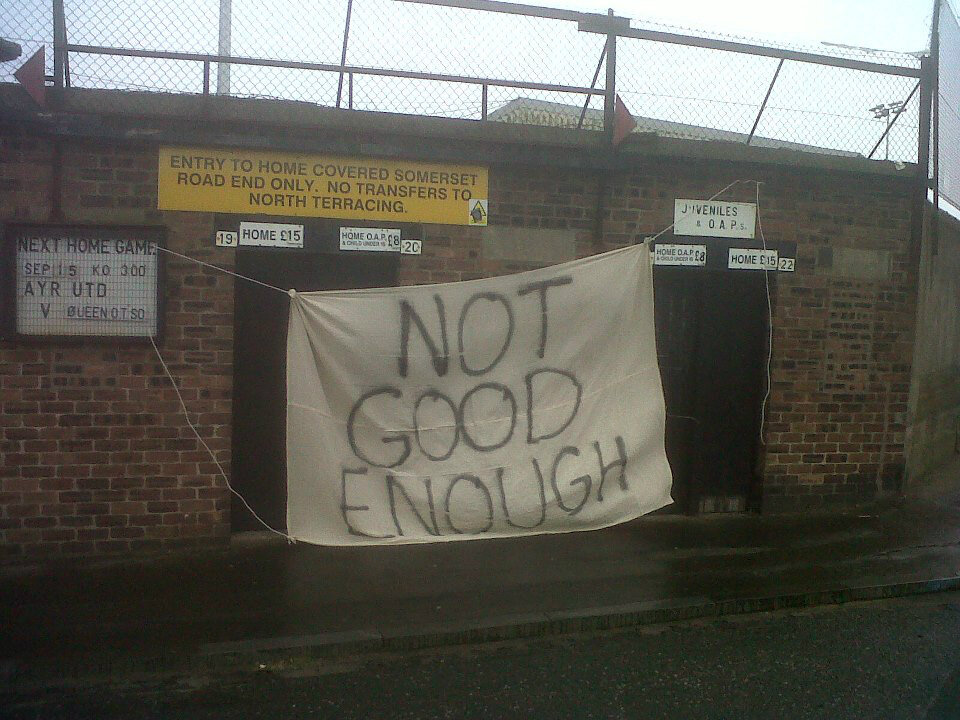
A humiliating 3-1 defeat away to East Stirlingshire on the opening day of the season was countered by a tantalising demonstration of the way it was supposed to work.  Clyde were routed 6-1 but, after conceding a last minute equaliser to Stenhousemuir at Somerset Park, Ayr went on to lose four of their first five league matches.  A 2-0 reverse at Stair Park saw the Roberts and his players return to the sight of Somerset Park festooned with a banner giving a blunt assessment of their efforts.


Fans showed their displeasure after just four league games
Sixteen points from the next 21 available served to turn down the heat on Roberts but performances failed to convince: two of Ayr’s five wins in that run of results – against bottom sides Albion Rovers and Stranraer required last minute penalties.  Even a 3-0 win over Brechin City, achieved with ten men, could be downplayed in hindsight by the paucity of the opposition.  Ayr, for all but the briefest of glimpses, struggled to recreate the football demonstrated in pre-season.  

The season’s nadir (just shading the defeat at Stranraer) came at Cliftonhill on Boxing Day.  In themselves, the surroundings served as a sobering reality check but nothing compared to the performance on the field.  A lethargic, hapless, rabble took to the pitch in white shirts that day, seemingly without a game plan to break down a very limited side and at full time Roberts became embroiled in a heated exchange with a supporter.  Ayr were meant to have turned the corner but the 2-0 defeat represented a fourth consecutive loss and, just three points from the foot of the table, Mark Roberts was back to square one, his position under intense scrutiny.  There has been no significant improvement in results since then, either, with just one win and three draws from six games.

The reason for Ayr United's position does not require over analysis: defensively they have been very poor, as discussed in more detail in mid-September. Because of injury (rather inevitably to Martyn Campbell and John Robertson), departures (Tiffoney) and arrivals (McAusland and Twaddle) and Roberts' attempts to find the right balance, Ayr's defence at the start of the season was in a near constant state of flux. Unfortunatly, this did not resolve itself when a more regular back-four of McAusland, Brownlie, McCann and Twaddle was deployed.

The defeat – and aftermath – to Albion Rovers did seem to create the crisis situation Ayr’s position deserved.  The manager took the unprecedented step of calling for supporters to rally round.  That interview mentioned the number of young players featuring for Ayr this season. Indeed against Rovers six players under the age of 20 were on the field together for the majority of the game, but in truth it has been the more senior players, brought to the club by Roberts (and mostly former teammates), who have disappointed this season.  United's best and most consistent performer has been 18 year old Robbie Crawford, without question.

Roberts also warned fans that there would be no quick fix. "We’re not one of those clubs that can throw £500 at a new player... I do not want to moan about budgets though".  However, one month on and throwing money at new players was exactly what Roberts was able to do.  A £7500 sponsorship from the Club's 'development partner' has been, quite incredibly, been usurped by an additional £20000, and rising, thanks to the fundraising efforts of Somerset Boab (including sizeable donations from Chairman Lachlan Cameron and sponsors Bodog). 

Unquestionably the money, to be used exclusively to boost playing budget, is a huge fillip to Mark Roberts and very welcome.  However, a note of caution. With the cash windfall comes a significant pressure – and the undermining of a huge excuse for Mark Roberts.  Ayr United’s results simply must improve in the remaining three months of the season.  If they do not, Roberts has very few places left to hide when it comes to pointing the finger of blame.  Any attempt to plead poverty (already a questionable line of argument when compared to Ayr's Second Division rivals) will simply not stand up to scrutiny.  With a contract in place for next season, Roberts' position is relatively secure but he will do little to enhance his reputation, or convince the doubters, if Ayr cannot finish the season strongly.

Adding to the pressure upon Roberts is that signing players in January, especially those with experience as required at Somerset Park, is not easy.  The quality of the three players signed – Neil McGregor and Chris Smith, out of favour at Dundee and Falkirk respectively, on loan and striker Liam Buchanan, who has returned from Ireland’s summer season – is therefore pleasing.  In particular, McGregor and returning hero Smith are both the dominant centre-half type the side has been missing since as far back as August, when Martyn Campbell again broke down.  Roberts was well aware of this deficiency, but was clearly unable to address it.  Various combinations of McCann, Robertson, Brownlie and McAusland have all failed to convince.

There has been some improvement in recent weeks, arriving from a change in formation. Earlier in the season Roberts played 433 and 4312, largely due to the lack of natural wide players at his disposal (Micheal McGowan could have made a real difference this season, alas his signing appears to have been folly. McGowan managed only 237 minutes before succumbing to the knee injury he seemingly hadn't recovered from). The signature of Micheal Donald, a natural left sided midfielder, has allowed Roberts to play a more traditional 442 in which the players look more comfortable and the side more balanced.  Donald, whose last club was Maybole Juniors, seems an unlikely kingpin but impresses with every game.

The big question is what are Ayr’s expectations now?  The assumed level of expenditure demands that simply avoiding relegation will not be good enough (not that it ever was).  And hence aspirations of a promotion play-off spot are raised.  With 15 league games to play, the Honest Men, in eighth, are nine points off 3rd position. The matter is further complicated by the potential value of two games versus Rangers in the Second Division next season and the, yet unclear, implications of league reconstruction. Regardless, Mark Roberts needs to quickly start winning games. Whether this enables a genuine tilt at promition is not of primary concern. 

McGregor, Smith and Buchanan showed glimpes of their value at Alloa on Saturday, but again Ayr threw away a two goal advantage, managing only a draw. This, more than anything, has been the side's bête noire this season - 23 points have been dropped for a winning position.  Mark Roberts' managerial career is dependant on seeing some tangible return on the money, a large proportion of it from the pockets of supporters, at his disposal. If not, that money will fuel the fires that say he is not the right man for the job.


* I hadn't completely given up writing about football, contributing periodicially to the excellent Tell Him He’s Pelé site - the place for thought and insight on the Scottish Football League. Take a look if you haven’t done so already

26/07/2012

Five things learnt from pre-season

Pre-season. Every year I resolve not to bother. Somerset Park can seem a long way and £10 can seem a lot of money to see a kick about. The resolve never lasts, however, and the pre-season optimism and intrigue over new players takes over. Managers will tell you that pre-season games are not about results and all about match fitness but new gaffer Mark Roberts was also keen to use the series of five games to work on the team’s shape and style of play, which has already seen a radical overhaul.

It can be dangerous to read too much into pre-season but the Honest Men can be reasonably pleased with their endeavours, drawing one-each with Queen’s Park, a full strength Bolton Wanderers side and Irish hatchetmen Glentoran. A thumping 4-0 win over Champions League-bound Motherwell had heads turning while a 4-1 defeat versus Partick Thistle reflected the number of youngsters and trialists on show, with Roberts resting most of his main men.

Notwithstanding (well, ignoring) the main caveats: what did we learn from United’s pre-season?:

Starting XI

Unlike pre-seasons of the recent past, United have fielded a fairly settled line-up and used only a limited number of trialists, with the exception of the Partick Thistle game. Goalkeeper Ally Brown and the Jonathan Tiffoney were the only players not involved in the opening fixture at Lesser Hampden. Former Stenhousemuir goalkeeper Brown featured as a second-half substitute in Ayr’s second game against Motherwell and has kept the No. 1 jersey since (and subsequently signed) while Tiffoney returned to action in the penultimate game versus Bolton.

This continuity of selection should stand the side in good stead when the action starts for real on Saturday. Barring injury the side to face East Stirlingshire is likely to line-up:

Brown

Tiffoney   J. Robertson   Brownlie  McCann

Merenghi   Sinclair   McStay   Shankland

R. Robertson   Moffat

Otherwise, Martyn Campbell has the biggest claim to be involved in place of Brownlie but Ochilview’s artificial surface may be the deciding factor in Marko’s decision. Also, there is some confusion regarding Tiffoney’s future. Dundee, apparently, remain interested but unwilling to pay a fee for the 20 year-old. It may be that John Robertson plays at right-back with Campbell and Brownlie pairing up in the centre.

Squad

Beyond the starting eleven, pre-season has shown Ayr’s squad to be fairly limited in numbers. Add Martyn Campbell and the manager himself to the eleven listed above and that’s it in terms of ‘senior’ squad members. Roddy Paterson and Robbie Crawford head the list of U19s that can be expected to be involved, while defender Alan Murdoch has also featured.

Of the trialists used but not signed, David Winters, Paul Harkins and Grant Mosson were given limited game time and mostly failed to impress. Unfortunately for Micheal McGowan, and for Ayr, his appearance as a trialist lasted only 5 minutes before he succumbed to a reoccurrence of the knee injury picked up at the end of last season. McGowan has claimed it not to be serious – and he scored in a ‘Reserve’ game against Cumnock on Wednesday night – but Mark Roberts cannot afford to offer the winger a deal until he’s certain he’s fully fit.

Congolese-born forward Joel Kasubandi remains an option but injury prevented him taking part in the final pre-season game. Somewhat of a wildcard, the speedy19 year-old and could be utilised on the left or up-front thus providing cover for Moffat and Shankland but this would seem to knock Roddy Paterson down the pecking order. Roberts will have to be sure Kasubandi will: a) fit into his vision for the side and b) provides something he doesn’t already posses amongst the U19 squad before gambling on the player released by Morton.

The financial uncertainly following the ongoing fallout from the Rangers saga may have lead to the re-evaluation of Roberts’ budget or Marko could be playing the waiting game to see who he can pick up in August and September but it seems certain that some reinforcements will be required.

Style

It has been clear from the off that Roberts wants his side to play a different way than under Brian Reid. This is also reflected in the players who he has brought to the club. Reid favoured a fairly defensive back-four where the full-backs we’re encouraged to get forward and in midfield the emphasis was primarily on carrying the ball forward, with the likes of McGowan, Trouten, Geggan and the out-of-position Moffat preferring to run with the ball rather than pass it.

The new look Honest Men have instead looked, first and foremost, to pass the ball, short and at speed. New midfielders David Sinclair, Ryan McStay and Antony Merenghi all look comfortable with the ball at feet with Sinclair adopting the ‘quarterback’ role of taking the ball deep from the defence and distributing it forward. With a relatively narrow midfield – there are no natural wingers – the full-backs have been encouraged to push forward, with the nominal left and right midfielders providing cover. This was shown to good effect with Tiffoney’s role in the equaliser against Bolton, where, receiving the ball from Roberts he burst past the Bolton full-back and defender to cross the ball to Roberts around the penalty spot.

Up front, Roberts has returned Micheal Moffat to his rightful position and put his faith in Ross Robertson. Brian Reid saw Robertson as a centre-back, used him there and in midfield but Marko has seen enough to convince him the 21 year-old can lead the attack. While it may take time for ‘Rossco’ to adjust to the role, what he lacks in touch he more than makes up for in his ability to occupy defences with his strength and aerial prowess. Too often in recent seasons opposition defenders have been given an easy time of it by Ayr’s attack and hopefully Robertson can address this. Robertson provides the ‘big man up front’ option missing from Ayr teams for a long time but I don’t expect Marko will be keen to see long balls being played from back to front. As a target man, however, there are signs that Robertson could prove a useful foil for a hopefully rejuvenated Moffat.

Going from ‘up against it’ in the First Division to among the title favourites in the Second was always going to necessitate a switch in approach that would see Ayr more comfortable on the front foot. Under Reid, last time out in the Second Division, United never looked to be comfortable favourites and rarely dominated games. Hopefully playing a more possession oriented game will prove not only more effective but also more attractive on the eye. The key to turning possession in to goals will be using Moffat’s pace to run at defenders and to exploit space behind opposition defences.

Shankland
 
The highlight of pre-season has been the emergence of Mark Shankland. Roberts has talked up the Mauchline kid almost since the day he took over and the youngster – who only turned 17 two weeks ago – is sure to play a big part this season on the evidence of pre-season.
 
Used primarily on the left of midfield, Shankland also played behind a front two (Moffat and Roberts) in the Queen’s Park game and Roberts has stated he can play anywhere across midfield or up-front. Shankland possesses fantastic technique and composure on the ball. His weight of pass is exquisite and he isn’t afraid to take on his man or to take a shot.
 
Why we didn’t see more of Shankland under Reid remains a mystery but this could now be his time to shine.
 
Suspect
 
(OK, I was struggling for a fifth ‘S’…) The biggest cause for concern on the park has been the number of free headers given up at corners and free-kicks. This very specific thing has been a long-running Achilles heal of United. There has been much debate surrounding Campbell at the start of what will be his seventh season at Somerset Park. Campbell’s strengths and weaknesses are fairly plain to see. He isn’t going to look comfortable with the goalkeeper rolling the ball out to him short, but at the same time up against a burly target man, few get the better of the now 31-year old defender as evidenced by his performances against Motherwell’s Michael Higdon and England International Kevin Davies. Then there are the inevitable question marks over his fitness. ‘Bobo’ managed only 15 appearances last season and Ayr had a fairly rotten record when he did start.
 
The jury is still out on keeper Ally Brown also. He doesn’t come with glowing recommendations from supporters of previous clubs and in pre-season has looked unsure when going for balls played into the box. If the defence can prove itself to be be solid and reliable then the side should have an excellent platform for playing the type of game Roberts wants.
 
To finish on a negative would be entirely inconsistent with the overall feeling around club about the new season. Fairly natural at the start of any season you could say, but in Mark Roberts we have a manger committed to entertaining the supporters with attacking and attractive football and that is to be welcomed. As usual, I’m sure it will be a rollercoaster season.

07/06/2012

"We were so near and yet so far"

Analysing Brian Reid’s tenure at Somerset Park

It was Sheryl Crow who once sang “a change would do you good” while Cat Stevens countered “It's not time to make a change. Just relax, take it easy”.  I can only imagine that the singer-songwriter, multi-instrumentalist and prominent convert to Islam hadn’t accounted for the conclusion of Brian Reid’s 4 years and 205 days in charge at Somerset Park.

Cat Stevens: wrong on this occasion

After a season that was at times odd-defying, claiming no fewer than three SPL scalps on the way to three quarter-finals and a semi-final at the National Stadium, Ayr United were relegated via the play-offs in heartbreaking fashion at Somerset Park by old adversaries Airdrie. In the context of a poor semi-final, first-leg performance at the Excelsior Stadium, where Ayr were lucky to escape with a goalless draw, from the ominous moment 17 year-old Jackson Longridge was sent off just 17 minutes into the second-leg a dark cloud descended over the old ground and a second relegation in three years - and the end of Reid's spell in charge - seemed inevitable.  The news that Ayr United and Reid, at that point the fourth longest serving manager in the country, were to part company came three days later.

The agreement not to renew Reid’s contract was mutual, with both the club and manager looking to take a new direction.  Most fans also agreed his time was up. In a rare insight to the intentions of Chairman Lachlan Cameron, a statement on the official website announced the club’s wishes to place a greater emphasis on the ‘youth pathway to the first team’ and that in view of the ‘changing landscape in Scottish football’ a change had to happen. For Brian Reid’s part, it was time for a fresh challenge.  Seaking to the Ayrshire Post on his departure, Reid said "even if we had stayed up in the First Division, the decision would probably have been the same".  To what degree the budget cuts implicit in the Board’s new direction influenced his decision is open to speculation but it has been suggested he was unhappy.

Farewell Brian.
Assessing Brian Reid's spell in charge at Somerset Park is a difficult task. On paper, two promotions, coupled with relative cup success is a noteworthy achievement for someone who started as a 37 year-old rookie with little coaching experience at a club like Ayr United. But four league campaigns also have to be considered in relative terms and alongside the reasonableness of expectation.  Here, the part-time dynamic is perhaps crucial. While I have previously decried Reid for constantlybeating the part-time drum as an excuse, there can be no doubt that United’s part-time status had a bearing on what Reid has achieved and what he could have been expected to achieve. But it doesn’t tell the full story.

Reid inherited an apparently unhappy dressing room in October 2007 – just 10 league games into the season – after Neil Watt had attempted to recreate his double promotion-winning Stranraer side of 2003/04 and 04/05 but found his methods to be unwelcome. Reid moved quickly to shake up the squad: most of the ‘Stranraer six’ were released (Higgins, Hamilton, Corr, Swift), Micheal Moore was ushered to the sidelines and in came a number short-term loan signings, including Dean Keenan and Willie Easton. Ayr finished the season in 7th place, the same position they were when Watt resigned.

The players brought to the club during Brian Reid’s first six months in charge – and first close season – demonstrated perhaps Reid’s greatest strength: player recruitment.  Reid proved to be adept at squad building and bringing better players to the club.  He probably leaves in credit when the good signings are balanced against the bad.  The team built – virtually from scratch – to tackle the Second Division in summer 2008, winning promotion via the play-offs best demonstrates this. Stephen Grindlay was an ever present between the posts and was, and still is, a solid goalkeeper; Dempsie, Walker, Campbell and McGowan were a solid back-four.  In midfield, Chris Aitken joined Ryan Stevenson (already at the club) and Keenan and Easton in making over 30 appearances and upfront the scoring prowess of Bryan Prunty and Alex Williams was supplemented by David Gormely and, from January, Mark Roberts.  While, for example, Chris Aitken had his (vocal) detractors, it’s hard to argue that any of the mainstays of that squad recruited by Reid were bad signings. 

Chris Aitken: unpopular but a good signing?
Ayr’s relegation the following season would call into question these credentials. United kicked off their Centenary season with the manager putting faith in the majority of the squad that had won promotion via the play-offs. Defenders Alan Dempsie and Scott Walker were the only regular starters from the previous season released, with Billy Gibson and Andrew Aitken coming in as replacements along with Craig Samson to provide competition to Grindlay.  The less said about David O’Brien’s Ayr United career the better.

The side did not start the season well.  Ayr’s 1-0 at home to Dunfermline at the start of December was just their second of the season and meant they were already six points adrift of 8th position but two ahead of bottom placed Airdrie.  To Reid’s credit, he had already identified that reinforcements were required and throughout the following months.  Ryan McGowan, Danny Lafferty, Chris Mitchell, Rocky Visconte and Stephen Reynolds and Danny McKay all came in on loan.  Veterans Junior Mendes and Steve Bowey renewed acquaintances with former team-mate Reid and Tam McManus returned from Ireland with the promise of goals.

But it wasn’t enough. Four wins and no defeats in eight games between mid-February and mid-March offered hope.  Ayr jumped out of the relegation places for five weeks and with nine games left to play were on the same points as Morton with a game in hand, and nine ahead of Airdrie – but Ayr finished the season disastrously.  Eight defeats interrupted by a solitary victory at Firhill meant that United finished 10th, two points behind Airdrie in the play-off position and six behind Morton in, who defeated Ayr in the final game of the season. Three weeks previous, Airdrie United had travelled down to Somerset Park on a Wednesday and left with crushing 4-1 victory which had narrowed the gap to just three points at the foot of the table. It was perhaps the worst performance of Reid’s spell in charge, even worse than the following Saturday when Inverness sealed the title with a 7-0 rout.

This spectacular collapse is a major black mark on Reid’s report card. Failure to beat Raith Rovers to the title the previous season was a disappointment softened by play-off success. Finishing below Airdrie United – the First Division’s only other part-time side – in the manner in which Ayr did was a major failure.

Following relegation Reid was given the opportunity to rebuild once more.  A previous blog post chronicles that season from the perspective of Ayr’s main rivals that season: Livingston.  Two seasons previously, Ayr and Raith competed mainly as equals.  This time round the West Lothian club had an advantage as the Division’s only full-time side. The Honest Men did have the opportunity at the start of February to close the gap between the sides to one point (United having a game in hand) but the Lions won 3-0 and went on to win the title by 23 points.

Ayr were partly undone by a combination of bad weather – just two league games were played between the end of October and start of January – and a Scottish Cup run that saw them reach the quarter-final, defeating Hibs in a replay at Somerset Park on the way. Of the resulting rescheduled fixtures played mid-week, Ayr won just one of six.  Reid’s side fell well short of the standards set in his first full season in charge – earning 15 fewer points, losing over twice as many games – but again the season was redeemed by triumph in the play-offs.  While few United fans present will forget the scenes of jubilation at Glebe Park at full-time, until Mark Roberts grabbed an equaliser with 13 minutes to go it was beginning to look like a lost cause. Such are the fine margins that define Reid’s managerial reign.

In assembling a squad for a second attempt at the First Division survival, Brian Reid again had to go back to the drawing-board. Alan Martin, the former Scotland U21 keeper brought in as Reid quickly realised first choice David Crawford wasn’t up to the job, and central midfield partnership of Ryan McCann and Scott McLaughlin left for full-time football elsewhere. Kevin Cuthbert, Andy Geggan and Micheal McGowan proved to be adequate replacements, and experience was added in the shape of the returning John Robertson and Gareth Wardlaw.     

Reid’s biggest error this season, however, was not bringing another centre-back to the club. Ayr started the season with a back four of John Robertson, Campbell, Smith and Malone but injuries and suspensions meant they started just four league games – and finished just one.  Campbell endured (another) injury hit season, starting only seven league games. A straight replacement for Campbell would have negated the requirement for wholesale defensive changes: full-backs Robertson and Malone, Ross Robertson and even Andy Geggan all stepping in to partner Chris Smith, often weakening other area of the team. Mid-season, Liam Tomsett was an important capture on loan from Blackpool and was a definite upgrade on Alex Burke (perhaps Reid worst signing ever) and Jamie McKernon alongside Andy Geggan in centre midfield. Sean Higgins and Keigan Parker were added as a 4th and 5th striker - but no defender.  

Alex Burke: one to forget
The similarities between 2010 and 2012 are striking. With ten games to go, Ayr were in eight place and had been there for four weeks. This time round the gap over the side at the bottom (Queen of the South) was six points and two points ahead of Raith in 9th. In both seasons Ayr’s 27th game was away to Raith Rovers and United fans travelled to Kirkcaldy in big numbers. Hopes of First Division safety were raised and then dashed as United conceded last minute equalisers.  Like in 2010, this set back proved to be the catalyst for an end of season collapse. It was the start of three games in quick succession versus relegation rivals, Rovers, Morton and Queen of the South. Brian Reid’s men failed to win any of them: drawing at home to Morton and losing 2-1 away to Queen of the South. Ayr had blown the opportunity to almost secure their safety. Haunted by the spectre of throwing it away again, wins against Livingston and Dundee, thanks to two spectacular goals from Keigan Parker, weren’t enough to avoid the play-off position and Raith and Morton picked up the points required to stay ahead of the Honest Men.

While 9th position was an improvement on last time in the First Division, particularly in a league where Ayr were the only part-time side, but any sense of achievement was soon to be diminished as Ayr crashed in the play-offs where yet another vital game – ironically again against Airdrie at Somerset Park – was lost. A United team under Brian Reid beaten by a side that was better organised and drilled and looked like they wanted it more.

This brief sojourn through Reid’s four full seasons in charge indicates a number of recurrences: losing vital games at important times of the season; poor end-of-season form and a huge turn over in players from one season to the next, even during seasons. 

The turnover of players partly reflects the state of Scottish football today and Ayr United’s standing – a part-time team somewhere between the First and Second Division. One year deals are the norm and players will inevitably be looking to for full-time contracts. Brian Reid was able to capitalise on the new economics in the game, recruiting decent players such as Eddie Malone, Ryan McCann and Chris Smith who in recent years would have commanded full time football. The criticism can be levelled at Reid, however, that he was always looking to improve his squad through new players rather than on the training ground.  It seemed that the solution (to not scoring goals, particularly) always lay with a new player and the excuses lay in an inability to find someone "better than we already had". 

On the park, a number of failings were evident and persistent.  While I think Brian Reid wanted his side to play 'the right way', they were often strangled by Reid's conservatism. Defensively, his first preference was for full-backs who were first and foremost solid. The likes of Alan Dempsie, Neil McGowan and even Eddie Malone (set-pieces aside) rarely offered anything in an attacking sense. The signature of Jim Lauchlan in Ayr's second promotion season to replace Jonathan Tiffoney typified this.  Forgetting the contribution in attack, defending balls crossed into the box, particularly in set-pieces was a constant short-coming of Reid's sides during his tenure.

Tactically, Reid was a fairly rigid 442 man. As mentioned above a defensive minded back-four left 6 players in attack with whom to grab the goals. But Ayr rarely seemed to click as an attacking force under Reid, other than in his first full season in charge when the team included Prunty, Williams, Gormley and Ryan Stevenson and netted 71 league goals. United's approach to goalscoring seemed ineffective. Often the side was criticised for over playing in attacking situations: 'walking the ball into the net'. While this is somewhat of an Arsenal inspired cliché, its true that last season Ayr heavily relied on set-pieces for goals, with Micheal McGowan responsible for around half Ayr's goals.

When not 442, Reid did go through spells playing 451, mostly in the First Division.  While was largely responsible for Ayr cup success and giant-killing acts in the cups,  it rarely transposed to league success. Instead, it effectively left United impotent, with little opportunity to win games. Reid argued that the system allowed for a 433 in attack, but this rarely materialised.  It was the cause of much frustration and failed to utilised the squad to the best effect (his used of Micheal Moffat on the left-hand side described as criminal by Mark Roberts). Also apparent was Reid's inability to alter his tactics during games to count opponents . All these thing pointed to a manager who could be reasonably described as tactically naive. This may be unfair, but Reid certainly didn't bring a sophistication to his approach. Much like his playing career it was very much 'safety first'. Or negative. 

Another failing of Reid was his reticence to use the talent coming through the club’s own Academy, particularly in favour of untried youngsters on loan. While no-one could argue with the value of some loan signings, for example Liam Tomsett and Ryan McGowan, many will struggle to recall the contribution made by the likes of Paul Willis and David Crawford.  This has been noted by the Board and was clearly a factor in their decision not to offer Reid a new contract.  Whether our Academy players are good enough is another debate – I guess we’re about to find out – but there have been glimpses and reports of great talents, none of whom have been given an opportunity.

Mark Shankland: the future?
In assessing the season just past, Brian Reid told the Ayrshire Post: “We had a small squad and the cup runs probably had an adverse affect on our ability to stay in the First Division.

 “If we had managed to stay up on the back of two good cup runs it would have gone down as one of the club’s best seasons.

“We were so near and yet so far.”

This can pretty much sum up his five years at the club.  So near and yet so far from the title in 2009. So near and yet so far from First Division survival in 2010. So near and yet so far from beating Kilmarnock in the biggest ever Ayrshire derby. So near and yet so far from staying in First Division in 2012. It was reasonable to expect Ayr to win the title in 2009, and to avoid relegation in 2010 and 2012, and they were in good positions to do so each season but, ultimately Brian Reid failed on each occasion. 

In the end, nearly wasn’t good enough.